Welcome to the Prominence Advisors Thought Leadership Series!01/12/2026
Welcome to Prominence Advisors’ Thought Leadership Series, where we explore the strategies, frameworks, and real-world use cases shaping the future of healthcare analytics and technology!
Each quarter, we’ll focus on a core theme influencing how healthcare organizations evolve: from data foundations and analytics maturity to advanced AI and intelligent automation.
Our goal is to move beyond buzzwords and trends, offering practical insight into what readiness really looks like, how organizations progress, and how to align technology investments to measurable business and clinical outcomes.
In Q1 2026, our focus is Data Science and AI maturity, examining how healthcare organizations move from foundational data capabilities to scalable intelligence, and why a use-case-driven approach is essential to realizing sustained value.
Healthcare is in the midst of a technological transformation. As organizations modernize their data infrastructure, they unlock a cascade of possibilities, from improved operational efficiency to predictive and generative AI that enhance patient outcomes.
But achieving scalable growth and true innovation isn’t about deploying the latest model or algorithm; it’s about maturing the delivery and consumption of data and aligning progress with use cases that demonstrate tangible value.
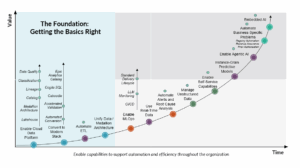
Every AI/Data Science data journey begins with foundational capabilities. In healthcare, this means establishing data quality, governance, lineage, and cloud infrastructure. A reliable data platform—often built around a lakehouse or medallion architecture—ensures that teams can trust their data and use it efficiently across the organization.
At this stage, healthcare organizations focus on:
These steps aren’t glamorous, but they’re essential.
Without a consistent, high-quality data foundation, the more advanced layers of AI and machine learning will struggle to deliver consistent value.
Even at this stage, use cases can help demonstrate quick wins while building momentum. For example:
These early, framework enabling outcomes establish credibility and show leadership that foundational investments directly support operational and clinical goals.
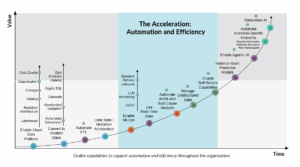
Once the foundational elements are in place, organizations can begin to scale automation and enable faster, data-driven decision-making.
You don’t have to wait for everything to be converted and positioned perfectly in the modern data platform. But you do need a solid framework for how teams operate—clear expectations for tools, data access, and governance.
Start enabling new capabilities that will help add to this framework like real-time monitoring, MLOps, and unstructured data management to move critical, valuable use cases from descriptive to diagnostic and predictive analytics. By automating alerts, root cause analyses, and operational workflows, hospitals and health systems can begin to free up resources and focus on higher-value initiatives.
This stage is about speed, scalability, value and trust—ensuring the data science infrastructure can grow as new technologies and data types emerge.
To demonstrate the growing value of automation, healthcare organizations might focus on:
Each use case adds a new capability to the organization’s data maturity framework while proving value against core priorities like cost savings, quality outcomes, or patient satisfaction.
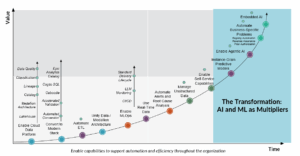
When healthcare organizations reach AI maturity, they begin to see exponential returns on their earlier investments. Machine learning models evolve from isolated use cases to embedded systems that support clinicians and operations in real time.
At this level, organizations can:
The result? Exponential gains in operational efficiency and cost reduction—without sacrificing patient outcomes. This is the maturity inflection point where healthcare organizations move from incremental improvement to transformative growth.
Each advanced use case should directly map to enterprise priorities such as clinical excellence, cost containment, and workforce sustainability:
These use cases not only demonstrate ROI but also build internal momentum for scaling AI-driven transformation.
As illustrated in the maturity model, true scalability in healthcare comes from integrating intelligent systems across the enterprise. By modernizing infrastructure and layering in machine learning and GenAI capabilities, organizations can build a self-improving ecosystem—one where automation, prediction, and insight are continuous and adaptive.
Healthcare’s next era won’t be defined by who has the most data, but by who can activate and embed it intelligently. The key is to continue approaching progress use case by use case, showing measurable value at each stage of maturity.
Those who invest now in maturing their data science and AI ecosystems, while aligning every new capability to organizational priorities, will lead the way in delivering scalable, personalized, and efficient healthcare.
If you’re exploring how to mature your data science and AI capabilities or want to understand where your organization sits on the maturity curve, Prominence Advisors can help. Our teams partner with healthcare organizations to assess readiness, design scalable architectures, and deliver use cases that drive meaningful results.